

NBC 2016 Part 4 – Fire and Life Safety (Guidelines) - India
Fire Prevention, Life Safety and Fire Protection Requirements for Buildings
NBC 2016 Part 4 is a section of the National Building Code of India published by the Bureau of Indian Standards (BIS) that establishes the minimum requirements for fire prevention, life safety, and fire protection in buildings. This part of the code provides guidelines for building design, construction, and fire safety systems to reduce the risk of fire hazards and ensure safe evacuation of occupants during emergencies. It applies to a wide range of occupancies including residential, commercial, industrial, institutional, and assembly buildings, and covers provisions related to means of egress, fire detection and alarm systems, fire fighting installations, and smoke control measures.
Scope of the Code
The code covers:
-
Fire prevention requirements in building design and construction
-
Classification of buildings based on occupancy and fire hazard
-
Requirements for means of egress including exits, corridors, and staircases
-
Fire resistance rating of structural and non-structural building elements
-
Fire detection and alarm systems
-
Fire fighting installations such as hydrant systems, wet risers, sprinkler systems, and fire pumps
-
Smoke management and ventilation requirements
-
Fire safety provisions for basements, atriums, and parking areas
-
Fire safety requirements for high-rise buildings
-
Fire command centre requirements and fire fighter access provisions
-
Guidelines for evacuation planning and life safety during fire emergencies
The provisions are applicable to:
-
High-rise buildings
-
Special buildings such as hotels, educational, institutional, mercantile, industrial, and hazardous occupancies
-
Buildings with large floor areas or basements
-
New building construction projects
-
Alterations, additions, or extensions to existing buildings where fire safety provisions are required
What is NOT Covered
This part of the code does not cover:
-
Detailed design procedures for specific fire protection systems (covered in individual Indian Standards such as IS 15105, IS 3844, etc.)
-
Operational fire brigade procedures and emergency response planning
-
Industrial fire protection standards specific to specialized processes
-
Fire safety requirements for ships, aircraft, and other transportation systems
Fire Safety Design Philosophy
NBC Part 4 emphasizes:
-
Prevention of fire hazards through proper building design and construction
-
Safe evacuation of occupants through adequate means of egress
-
Limiting fire spread through fire-resistant construction and compartmentation
-
Early detection of fire through automatic detection and alarm systems
-
Effective fire fighting installations for controlling and extinguishing fires
-
Integration of passive fire protection and active fire protection systems
-
Provision of special safety measures for high-rise and complex buildings
The code promotes a comprehensive fire safety approach combining prevention, detection, evacuation, and fire suppression measures to minimize risk to life and property.
NBC 2016 – Classification of Buildings Based on Occupancy
Buildings are classified based on their use or type of occupancy.
This classification determines the required fire protection systems, means of escape, and fire safety provisions for the building.
Main Occupancy Groups

Residential Buildings (Group A)
.png)
Educational Buildings (Group B)
.png)
Institutional Buildings (Group C)
.png)
Assembly Buildings (Group D)
.png)
Business Buildings (Group E)
.png)
Industrial Buildings (Group G)
.png)
Storage Buildings (Group H)
.png)
Hazardous Buildings (Group J)
.png)
NBC 2016 – Fire Protection Requirements Based on Building Height
In NBC 2016, fire protection requirements increase with building height because evacuation becomes more difficult and fire risk increases.
Building Height Classification

Key Fire Safety Systems Required in High-Rise Buildings

Important NBC High-Rise Safety Provisions

Why Building Height Matters in Fire Safety
As building height increases:
-
Evacuation time increases
-
Fire brigade access becomes difficult
-
Smoke movement becomes more dangerous
Therefore NBC requires additional fire protection systems in taller buildings to ensure life safety and effective fire fighting.
NBC 2016 – Fire Zones
Cities or areas are divided into Fire Zones based on the type of building occupancy and associated fire hazards.
This zoning helps control fire risk and regulate the type of construction permitted in different areas.
Classification of Fire Zones

Occupancy Groups in Each Fire Zone

Overlapping Fire Zones

Temporary Buildings

Construction Restrictions by Fire Zone

Existing Buildings
Existing buildings in any fire zone are not required to comply with new NBC provisions unless:
-
The building is altered or renovated
-
The building is declared unsafe
-
A change in occupancy occurs
Major alterations require approval from the local authority.
NBC 2016 – General Fire Safety Requirements for All Occupancies
1. Buildings Under Construction

2. Openings in Fire-Resistant Walls and Floors

3. Service Shafts and Ducts

4. Refuge Chutes

5. Electrical Installations (Fire Safety Related)

6. Emergency Power for Fire and Life Safety Systems

7. Diesel Generator Sets

8. Escape Lighting and Exit Signage

9. Air Handling Units and Smoke Control

10. Fire Dampers

11. Boiler Rooms

12. Fire Command Centre (FCC)

Key Takeaway for Fire Protection Engineers
The most relevant provisions in this section relate to:
-
Fire resistance of shafts and openings
-
Emergency power for fire systems
-
Exit lighting and signage
-
Fire dampers and smoke control
-
Fire command centre requirements
-
Fire safety during construction
NBC 2016 – Fire Protection Systems
NBC 2016 – Fire Protection Systems
Fire Extinguishers and Fixed Fire Fighting Installations
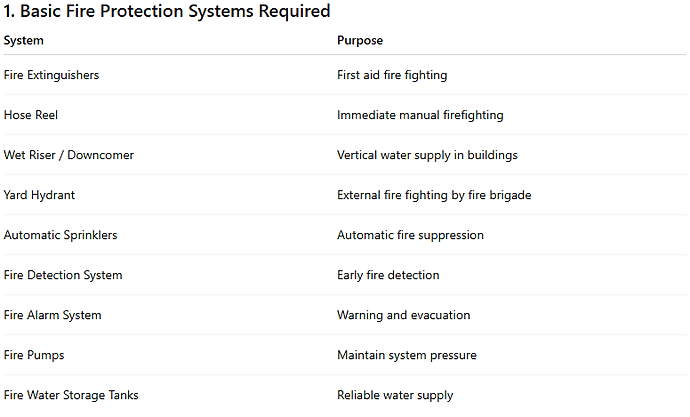
Buildings must be provided with appropriate fire protection systems depending on the occupancy classification, building height, and fire risk. The objective is to ensure rapid detection, control, and suppression of fire to minimize risk to life and property.
Fire protection systems may include:
-
Portable fire extinguishers
-
Hose reel systems
-
Fire hydrant systems
-
Wet riser or down-comer systems
-
Automatic sprinkler systems
-
Water spray systems
-
Foam fire protection systems
-
Gaseous suppression systems
-
Dry powder extinguishing systems
These systems must be designed, installed, and maintained in accordance with accepted standards and engineering practices.


NBC 2016 – Fire Pump Requirements (Design Guide)
Fire pumps are installed to ensure adequate water pressure and flow for fire protection systems such as hydrants, sprinklers, and hose reels.
The pump system must be capable of supplying the required water demand during fire emergencies.


NBC 2016 – Fire Water Storage Requirements
Fire water storage tanks must be provided to ensure adequate water supply for firefighting operations. The required capacity depends on the building occupancy and fire protection systems installed.
Fire water may be stored in:
-
Underground tanks
-
Ground level reservoirs
-
Terrace tanks
The storage must be dedicated for firefighting purposes.


Key Design Points for Fire Protection Engineers
When designing fire water storage systems, engineers must ensure:
-
Adequate water volume for fire duration
-
Reliable pump suction arrangement
-
Easy maintenance and inspection
-
Proper fire brigade accessibility
The fire water storage system must ensure continuous water supply during fire emergencies.
NBC 2016 – Table 7
Minimum Fire Fighting Requirements (Simplified Guide)
Legend:
R = Required
NR = Not Required
.png)
%20above%2015m.png)
.png)
.png)
.png)
.png)
.png)

Key Notes for Fire Protection Engineers
-
Sprinklers must be installed in basements larger than 200 m².
-
Buildings above 15 m height cannot be permitted for certain occupancies without fire protection systems.
-
Pump capacity is based on covered area of the building.
-
One pump set is required for every 100 hydrants.
NBC 2016 – Fire Protection Design Quick Guide


Frequently Asked Questions (FAQs) – NBC 2016 Fire Protection
1. What is NBC Part 4 in India?
NBC Part 4 of the National Building Code of India (NBC 2016) covers Fire and Life Safety requirements for buildings. It specifies rules for fire prevention, fire detection, firefighting systems, means of escape, and fire protection installations such as hydrants, sprinklers, and fire pumps.
2. When is a sprinkler system required as per NBC 2016?
Automatic sprinkler systems are required in many buildings depending on occupancy type, building height, and floor area, as specified in Table 7 of NBC Part 4. Sprinklers are commonly required in:
-
High-rise buildings
-
Basements larger than 200 m²
-
Mercantile buildings and malls
-
Industrial buildings
-
Parking areas
-
Certain residential and hotel buildings
3. What is considered a high-rise building in NBC 2016?
As per NBC 2016, a high-rise building is any building with height above 15 meters measured from the average ground level to the terrace level.
High-rise buildings must have additional fire safety systems such as:
-
Wet riser systems
-
Fire pumps
-
Fire command center
-
Automatic detection systems
4. What is the difference between wet riser and downcomer systems?
A wet riser system is a vertical pipe permanently filled with water and connected to fire pumps.
A downcomer system is used in buildings where water is supplied from terrace tanks and the pipe normally remains dry until used.
SystemTypical Use
Wet riserHigh-rise buildings
DowncomerMedium-height buildings
5. What fire pump capacity is required as per NBC?
NBC recommends typical fire pump capacities such as:
-
Main fire pump: 2280 LPM
-
Diesel standby pump: 2280 LPM
-
Jockey pump: 180 LPM
The actual pump capacity depends on the hydrant and sprinkler system demand.
6. What is the minimum fire water storage required in buildings?
Fire water storage requirements depend on the building height and occupancy. Typical values are:
Building HeightUnderground Tank
Up to 15 m10,000 – 50,000 L
15 – 24 m50,000 – 100,000 L
24 – 45 m100,000 – 150,000 L
Above 45 m150,000 – 200,000 L
Most buildings also require a terrace tank of 5,000 – 20,000 L.
7. What pressure should be maintained in a fire hydrant system?
As per NBC guidelines, the maximum pressure at hydrant outlets should not exceed 7 bar to ensure safe operation by firefighters.
Pressure reducing valves may be used in tall buildings to control pressure.
8. Are sprinklers required in basements according to NBC?
Yes. NBC requires automatic sprinklers in basements larger than 200 m². Basements must also have:
-
fire detection systems
-
smoke extraction systems
-
fire hydrants
9. What is a Fire Command Centre in high-rise buildings?
A Fire Command Centre (FCC) is a dedicated control room located at the entrance floor of a high-rise building. It is used to monitor and control fire protection systems such as:
-
fire alarm system
-
sprinkler systems
-
fire pumps
-
smoke management systems
10. What is the maximum area protected by one sprinkler control valve?
According to NBC guidelines, the maximum floor area protected by a single sprinkler installation control valve is 4500 m², except for industrial or hazardous occupancies where special approvals may apply.
11. Are fire extinguishers mandatory in all buildings?
Yes. Fire extinguishers are required in all types of buildings as the first line of fire defense. The type and number of extinguishers depend on:
-
occupancy type
-
fire hazard classification
-
floor area
12. What fire protection systems are required in high-rise buildings?
Typical fire protection systems required in high-rise buildings include:
-
Fire extinguishers
-
Hose reel systems
-
Wet riser systems
-
Yard hydrants
-
Automatic sprinkler systems
-
Fire detection and alarm systems
-
Fire pumps
-
Fire command center
13. What is the role of a jockey pump in fire protection systems?
A jockey pump is a small pump used to maintain pressure in the fire protection system. It prevents the main fire pump from starting unnecessarily due to minor pressure drops.
14. Are fire detection and alarm systems required in all buildings?
Fire detection and alarm systems are required in many occupancies such as:
-
high-rise buildings
-
hotels
-
hospitals
-
shopping malls
-
industrial buildings
These systems help in early fire detection and evacuation.
15. Which standards are used for sprinkler design in India?
Sprinkler systems in India are generally designed according to:
-
IS 15105 – Automatic Sprinkler System Standard
-
NBC 2016 Part 4
-
Sometimes NFPA 13 for international projects.